
While browsing the Oculus Home I came across a VR experience called vTime. The program was described as a social experience, allowing users to from all over the world to meet and chat with each other. Since I always love talking with other VR enthusiasts, I decided to give it a try.
When you begin vTime, it takes you to a screen where you can customize your own personal avatar. This was the first thing that set vTime apart from other social VR experiences I have had. The customization screen was very in depth, providing viewers with a wide
range of skin tones, hair colors, and hair styles to choose from. vTime took a step beyond allowing players to choose from a fairly homogenous group of predesigned avatars by actually providing players with the resources to create an avatar with their same skin and hair.
Once I created my avatar, I was then taken to the “connections” screen. Here I could see dozens of bubbles floating around, each with an avatar picture and name. I could then choose a person, or group of people to connect with. If they accepted my request to join their group, I would be taken to whatever scene they were currently in.
One of the first locations I was taken to was the Arctic. There I sat with three other VR users, one of whom was from South Africa, and talked about where we were from and what made us interested in VR.
There is an incredible attention to detail in each of the various locations one can travel to in vTime. In the Arctic scene, when you and other talk, you can see your breath on the cold air.

In the location pictured here, you can see and hear the water splashing against the rocks.
The attention to detail didn’t stop there. The head tracking allowed me to make eye contact with others and the program made my hands and head move naturally when I spoke, making me begin to forget that I wasn’t actually relaxing in the river with a group of friends.
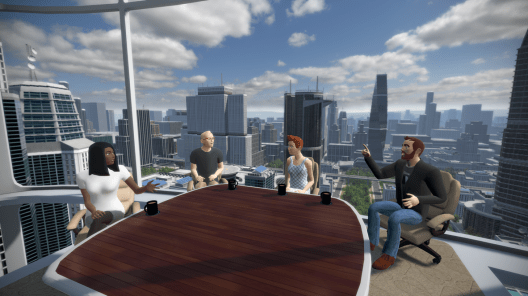
vTime has a wide range of uses. I could easily see myself using this as a way to conduct interviews with people I wouldn’t otherwise be able to meet in person. The boardroom location would even allow me and the other person to share photos with each other by projecting them on a big screen present in the room.
vTime will also be helpful to anyone collaborating on a project. It’s nice to be able to sit down face to face with a group working on projects, but sometimes that just isn’t possible. vTime is about as close to a physical meeting with other people as you can get. Rather that making a conference call, group members can meet in one of vTime’s locations to discuss their work and share photos of the projects.
The major element that set vTime apart from other social experiences was its compatibility with a wide range of VR headsets. In one group that I was with, each person had a different VR headset. I had a Rift, another person had a Vive, another had a GearVR, and the last person had a Google Cardboard. In order to meet with someone in VR, you don’t need to have a high-end headset, you can simply log on by using a smartphone and a Google Cardboard, thus helping to make VR more accessible to all.
vTime has the potential to change the way we interview, educate, or just hang out with friends. It can help us develop connections with other VR enthusiasts and find collaborators from all over the world. I look forward to seeing how it will progress as more advanced motion tracking is developed.
 Welcome to (virtual) reality
Leave a comment