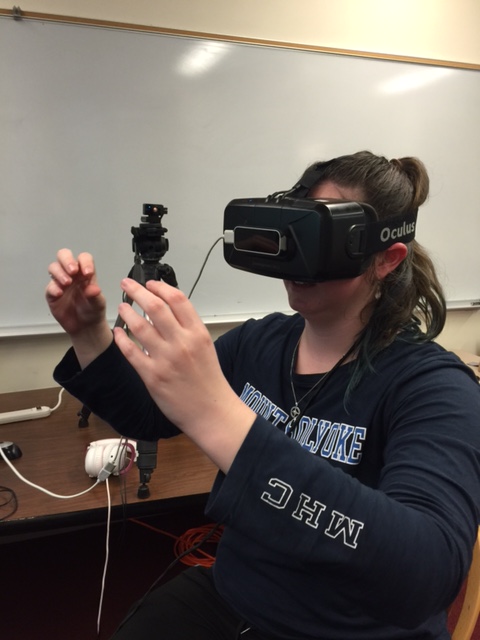
I was set to give a presentation to a group of college freshmen on April 7th. I had figured that my new Oculus Rift would arrive in time for me to plan some awesome, new demos to show the students. When I found out that my CV1 would not arrive when I thought it would, I was left scrambling to find something that would wow the students.
VR is visually impressive on it’s own, but I wanted to take it one step further than immersive graphics. I wanted something that would really get people excited.
I thought about my previous VR presentations and was reminded how everyone immediately tried to use their hands, even though it was not possible. That was it. I would demo the Oculus Rift and pair it with the Leap Motion to allow people to use their hands.
Having never tried the Leap Motion myself, I quickly downloaded Blocks and tested it out. I pulled the head mounted display over my eyes, Leap Motion snapped on its front, and fired up the demo.
I was amazed. Blocks was a lot more fun and impressive than I had originally thought it would be. I was able to lift my hands and see little, digitized version of them floating in front of me. I could pick up blocks by moving my hands around them. I could even create blocks with my fingertips. 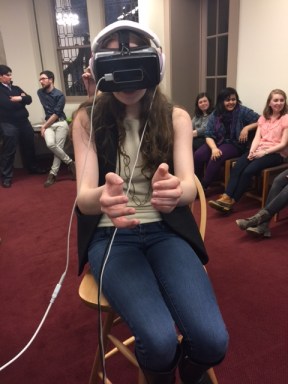
When it came time to present to the students, I let them try two demos: Blocks, described above, and Showdown, which moves the viewer through a slow motion fight scene between humans and a robot.
The most popular demo of the night was Blocks. While the students were very impressed with the realistic graphics of Showdown, they were more excited about the ability to use their own hands in virtual reality.
Even though the graphics of Blocks were not realistic, the addition of hands made the overall experience very immersive.
The longer I played in Blocks, the weirder my hands began to feel. At first, they felt too light, since I was seeing that my hands were holding a block, but in reality, they weren’t. Eventually, they began to feel tingly every time I grabbed a block. This experience was shared but the students who also tried the demo.
I’m not quite sure why my hands and others’ hands felt tingly. I’m sure it has something to do with the disconnect between what you are seeing and what you are feeling.
It is clear that the addition of hand tracking is vital to VR as it works towards creating a totally immersive experience. However, it makes me wonder what will be done about the disconnect between seeing and feeling. Both Oculus and Vive have hand tracking controllers and I wonder if physically holding a controller in your hand will eliminate the tingly feeling or work to distract the user from what it happening in VR.
Will the future of hand tracking in VR involve controllers, or will it ideally only use one’s own hands? Either way, the addition of hands put VR one step closer to becoming a fully immersive experience.
 Welcome to (virtual) reality
Leave a comment