The view directly below her was dizzying. She was hundreds of feet above the street. The scaffolding around her was rusted and shaky. Though she didn’t want to, she gave in to the crowd around her, urging her to stand up, to try to keep her balance on the thin, metal rail. Her ankles shook and her arms flailed out to steady her body. When she had enough, she slowly made her way back to the chair, to the safety and comfort of sitting down. But had her weight thrown the whole tower off balance? She screamed as the bar beneath her broke and she plummeted to the earth.
This is how Sightline: The Chair, a demo for the Oculus Rift, ends. In hindsight, this probably wasn’t the best way to introduce a group of people to virtual reality, but it did lead to some interesting discussion of reality versus the virtual.

Recently, I brought Oculus’ DK2 into a college class. Most of the students, if not all, had never tried the Rift themselves. I chose to show them The Chair demo because it involved very little movement. I hoped to avoid making everyone feel sick from running around some virtual world or riding a rollercoaster. In this particular demo, the user sits in a chair and just turns their head to look in all directions around them. Each time they look away and look back, something in the scene changes.
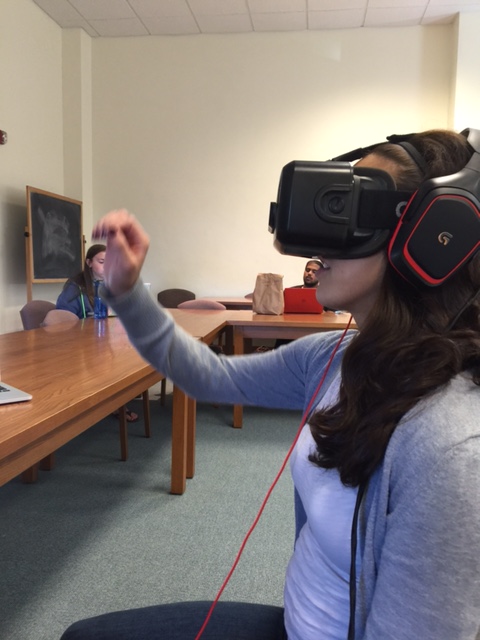
I let each person play through a portion of the demo until we got to the end. The last girl stepped up, sat in the chair, placed the HMD over her eyes and saw the scene I described about.
Up until this point, many people had commented that it took some convincing to believe in the simulation. They had to just not think so hard and believe what they were seeing.
However, the comments changed once fear was involved. During the simulation, when the girl stood up from the chair, it was interesting to see that she had her arms out for balance, as though she really were standing atop a thin beam rather than the classroom floor. When she felt she was losing her balance, she reached out and frantically tried to find the table in front of her.
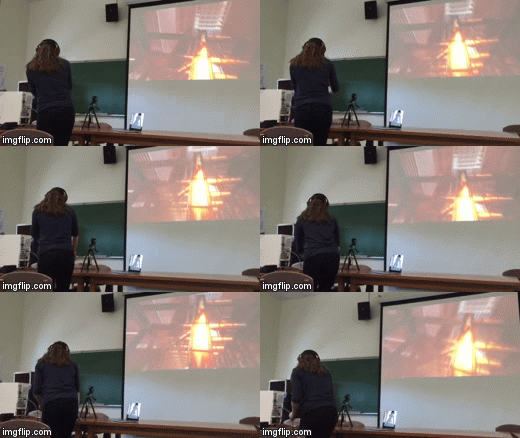
She wanted to use the table as a way to reorient herself to reality. She needed something solid under her palms in order to remind her brain she was standing in a classroom and not on a rusty, metal beam hundreds of feet above the ground.
The feeling of a strong emotion, in this case: fear, caused a switch to flip in her brain. Though earlier, when the simulation had you sitting in a meadow looking at birds, you were struggling to believe it, now your brain had to do the opposite. It took more thinking, and even physical action, to tell yourself it wasn’t real and that even if your chair fell from the scaffolding, it wouldn’t affect your actual body.
This realization got me thinking about horror. VR horror is terrifying. It is far scarier than horror movies as the monsters appear right in front of you in 3D. I am interested to see if people have the same reaction to horror that they did to falling from a great height. Will reaching out and grabbing a desk calm their fears, or will a greater sense of fear call for a greater grounding tool?
 Welcome to (virtual) reality
1 Pingback