
I had read a few articles about people trying the Oculus Rift for the first time. However, I still didn’t believe it. There was no way that putting on a clunky, heavy, head mounted display (HMD) could make you feel like you were in a small house in Italy. Maybe, if you tried hard enough, you could trick your mind for a brief moment. But there was no way it was easy.
When I finally had the chance to get my hands on Oculus’ first developer’s kit (DK1), I was skeptical. The HMD seemed too large to even hope of being comfortable. How exactly was I supposed feel immersed while a big, black box weighed down my face.
I held the Rift in my hands and carefully positioned it over my eyes and tightened the strap around my head. My fingers found their way to my keyboard to press the spacebar and start the demo.
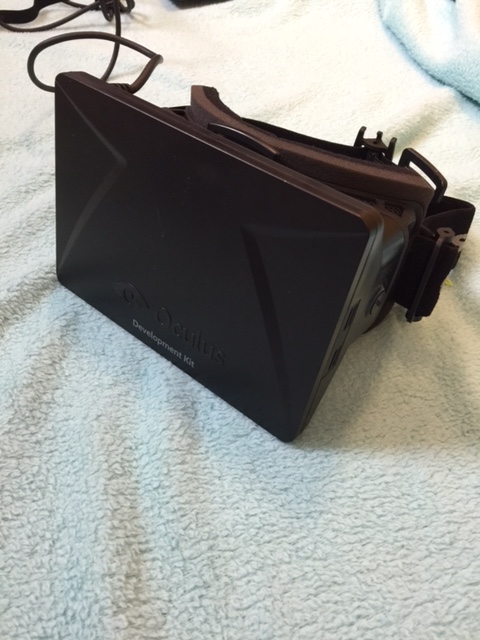
A new world was unveiled before my eyes. I was standing in front of a stairway, looking out at a room. Three feet in front of me was a smooth, wooden table. I held the arrow key and moved my view closer to the table. When it felt like I would run into the table if I took another step, I stopped. I turned my head and as I did, the view scanned the room and rested upon the staircase, now three feet away from me.
I was amazed. And honestly, a little nauseous.
DK1 had some amazing elements. I was surprised that I was able to so quickly forget that I was really sitting in a computer chair in my room. The objects in the room, like the table, felt like they were really there. I really felt as though I could reach out and touch them.
The Rift uses the way our eyes work to create this 3D effect.
Stare straight ahead. Now cover one eye with your hand. Without changing your gaze, move your hand to cover the other eye.
You’ll notice that each eye sees a slightly different image. The Oculus Rift uses the same concept. The HMD has two lenses that each show a slightly different image, thus creating the 3D effect.
However, it was clear that DK1 was still lacking. After spending just a few minutes inside of the Rift, I felt sick to my stomach.
There are a few causes for the nauseous feeling. One is something called the screen door effect. The view in DK1 was very pixilated. It looked as though you were looking at everything through a screen door.
Another cause is the fact that the Rift tricks your brain into believing that you are in fact moving. However, your body is staying still. This confusion causes you to feel sick.
When Oculus came out with DK2, I was eager to try it again.
The HMD, though still heavy, didn’t slide down my face quite as much as DK1 did. Though this was a small change, a strap added that goes over the top of your head in addition to the one that runs around your head behind your eyes, it made a huge difference. I no longer felt I had to hold the HMD up while in a demo. This made immersion much easier.
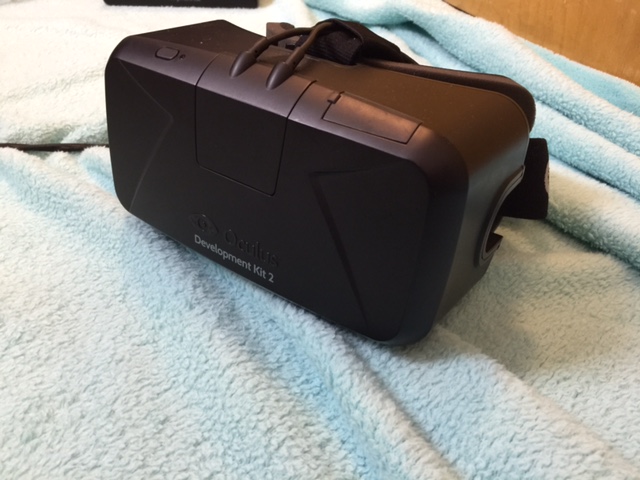
With DK2, the screen door effect was nonexistent. I found I could stay in the Rift much longer before I felt nauseous.
In addition to DK1’s head tracking when you moved your head left to right, DK2 added a depth element. I could now walk over to a table and lean in to study the papers that rested on its surface.
The improvement from DK1 to DK2 was tremendous. However, there is still a long way to go before virtual reality becomes easier to use. Despite the improvements, I still couldn’t stay in the Rift much longer than twenty minutes before I began to feel sick.
There is a long road ahead in the development of virtual reality and I am excited to see where Oculus takes us in 2016 with the release of CV1.
 Welcome to (virtual) reality
Leave a comment